
By Thomas Hope September 1, 2026
A store may show $25,000 in card sales for the day while the bank receives only $23,940. That does not automatically mean money is missing. Refunds, processing fees, chargebacks, reserves, tip activity, funding adjustments, and transactions settling in different batches can all change the amount or timing of the deposit.
For a business with several stores, the challenge becomes much harder. Finance may have dozens of locations, multiple merchant IDs, several processor batches per business day, different bank accounts, and automatic treasury transfers moving cash after deposits arrive.
A bank deposit is not the same thing as POS sales. Reconciliation succeeds when finance can trace every deposit back to the correct location, merchant account, batch, transaction period, and adjustment set.
The best reconciliation process does not ask only, “Did money reach the bank?” It asks which transactions created that money, what changed between gross card activity and net funding, which location earned it, when settlement occurred, and whether every difference has a documented explanation.
What Is Multi-Location Payment Reconciliation?
Multi-location payment reconciliation is the process of matching payment activity recorded at individual stores or operating locations with processor settlement records, actual bank deposits, and accounting entries.
A strong process works across three distinct layers:
- Operational layer: POS sales, tenders, refunds, tips, voids, and business dates.
- Payment layer: processor batches, merchant IDs, settlements, funding records, fees, reserves, disputes, and adjustments.
- Banking layer: posted deposits, ACH credits or debits, transfers, and cash movements.
These layers contain related information, but they are not duplicates of one another.
Authorization, clearing, and settlement are separate stages of a card transaction. Visa’s explanation of the payment lifecycle describes clearing as the exchange of transaction information and settlement as the subsequent transfer of funds between the issuer and acquirer.
A POS sale represents a customer transaction. A processor settlement represents transactions that have progressed through clearing and funding processes. A bank deposit represents cash that has actually posted to an account.
Visa describes the payment lifecycle as including authorization, clearing, and settlement, with settlement transferring funds between the issuer and acquirer after transaction information has moved through clearing.
That distinction matters because authorization does not itself prove that a transaction became part of a particular merchant deposit.
The basic multi-store payment reconciliation question should therefore be:
Can we move from a location’s card activity to the processor’s settlement record and then from that settlement record to the posted bank deposit without losing the identifying information needed to explain every difference?
Businesses using centralized platforms may benefit from the reporting and multi-location capabilities described in this overview of cloud-integrated POS systems, but cloud POS reporting still represents only one layer of the financial chain.
Why Cloud POS Reporting Alone Is Not Enough
Cloud POS reporting can provide excellent operational information. A typical platform may show sales, card tenders, cash, taxes, tips, refunds, voids, employees, stores, and batches from a centralized dashboard.
It may not, however, contain every item that changes the cash ultimately deposited by the processor.
For example, a POS could report $18,000 of card payments for a location while the processor’s funding record includes a prior-period refund, a chargeback debit, a reserve adjustment, or fees deducted before funding. The POS did not necessarily record those events incorrectly; they may have originated outside the POS transaction workflow.
This is why finance should distinguish three records:
POS Report ↔ Processor Settlement Report ↔ Bank Statement
The POS establishes what the business recorded as payment activity. The processor report establishes what the payment provider cleared, adjusted, and funded. The bank establishes what cash actually posted.
Square, for example, provides a reconciliation report intended to explain how collected payments become transferred amounts, including items such as refunds, partial payments, and split deposits. It also allows reporting by location. This is a useful provider-specific illustration of why sales reporting and deposit reporting can differ.
Cloud platforms can also integrate with accounting and other business systems, reducing manual entry, as discussed in this guide to cloud-based merchant services and payment integrations. Automation helps, but it does not eliminate the need to reconcile processor funding to posted bank activity.
The Three-Way Reconciliation Model
Three-way POS settlement reconciliation compares the operational payment record, the processor funding record, and the bank record rather than trying to reconcile the POS directly to the bank by amount alone.
The model is:
POS Report ↔ Processor Settlement Report ↔ Bank Statement
The first comparison asks whether the processor received and settled the payment activity that the POS expected it to receive. The second asks whether the settlement funding the processor says it issued actually appeared in the bank.
A third accounting control then connects the posted bank transaction to the general ledger:
Bank Statement ↔ GL
This creates a useful three-level control structure:
- POS-to-processor reconciliation
- Processor-to-bank reconciliation
- Bank-to-GL reconciliation
Suppose Store A reports $12,400 of card activity. The processor reports $12,250 after a $100 settled refund and $50 in deductions. The bank then posts a $12,250 ACH credit.
There is no $150 shortage. There is a fully explained gross-to-net difference.
Now suppose the processor reports $12,250 funded but the bank shows nothing. That is a processor-to-bank exception.
If the bank shows $12,250 but accounting posts $12,520, the payment itself may be correct while the GL import is wrong.
Traditional bank reconciliation alone may establish that cash exists, but multi-location payment reconciliation explains which locations, merchant accounts, batches, and settlement events created the cash.
Which Identifiers Connect a POS Batch to a Processor Deposit?

There is no universal field that connects every POS batch to every processor deposit. Different POS platforms, gateways, processors, acquirers, and banks expose different identifiers.
Finance should therefore build an identifier chain rather than depending on one field.
Common identifiers can include:
- legal entity;
- store or location ID;
- merchant ID, or MID;
- terminal ID;
- POS batch ID;
- processor batch number;
- settlement ID;
- funding ID;
- deposit or reference number;
- business date;
- settlement date;
- bank posting date;
- processor trace or reference;
- transaction IDs.
A merchant ID identifies a merchant relationship or processing account within a provider’s environment. A terminal or location ID may identify a specific processing endpoint or store. A batch ID generally groups transactions submitted or finalized together. A settlement or funding ID may identify a subsequent settlement or funding event.
Those identifiers should never be treated as synonyms.
Reconciliation Identifier Hierarchy
Where the available data supports it, a useful matching hierarchy is:
Location → MID → Batch → Settlement/Funding ID → Deposit Date → Amount
Location and MID come first because they establish whose payment activity is being reconciled. Batch and settlement identifiers then connect transaction groups to processor funding.
Date and amount should usually be supporting attributes, not the only matching criteria.
For example, three locations could each receive a $4,000 deposit on the same morning. Matching by date and amount alone creates ambiguity. Matching the associated MIDs and funding references removes much of that uncertainty.
A location-to-MID master file should normally include:
- legal entity;
- location name;
- internal store ID;
- processor;
- MID;
- processor account or hierarchy;
- destination bank account alias;
- GL clearing account;
- expected funding configuration;
- location time zone;
- active/inactive status.
Do not include unnecessary full bank account numbers in routine reconciliation files.
| Source | Identifier | What It Helps Match |
| POS | Batch ID | Transactions grouped by the POS |
| POS | Store/location ID | Activity to operating location |
| Processor | MID | Settlement to merchant processing account |
| Processor | Settlement/funding ID | Funding event to processor record |
| Bank | ACH/reference text | Posted deposit to funding source |
| Accounting | Clearing/deposit reference | Bank transaction to GL record |
Batch ID vs. Settlement ID
A batch ID generally identifies a collection of transactions processed or submitted together. A settlement ID or funding ID may identify the processor’s later financial event used to calculate or transmit merchant funding.
The relationship is provider-specific.
One batch might create one funding event. Several batches might be combined. A single settlement record might also be represented through more than one bank transaction under certain processor or account structures.
Clover documentation illustrates why configuration matters: transactions may remain authorized but unsettled until batching occurs, and its specific environment allows the settlement batch time to be configured. That behavior should not be generalized to every provider, but it demonstrates that batch timing is an operational setting, not a universal constant.
Finance should ask its own provider: Which field in the batch export is carried into settlement or funding reporting?
If the answer is “none,” reconciliation may need a composite key using MID, batch date, amount, and transaction-level references.
Why One Batch May Not Equal One Deposit
A one-to-one relationship between batches and bank deposits is convenient, but it should never be assumed.
Several batches may be combined into a single processor funding event. This can happen because of provider funding logic, multiple operating periods, batch aggregation, or processor configuration.
The reverse can also occur. One business day may produce multiple deposits because different locations use different MIDs, online and in-store payments follow separate channels, split funding is configured, or the provider generates more than one funding event.
Amounts may also change because of:
- netted processing fees;
- refunds;
- chargebacks;
- reserves;
- funding corrections;
- returned funding;
- prior-period adjustments.
Visa’s acquirer risk standards explicitly recognize that merchant settlement may involve credit transactions, disputes, fees, and reserve funds when applicable, which reinforces why processor funding may differ from gross transaction totals.
What Is a POS Batch and Which Date Belongs to It?
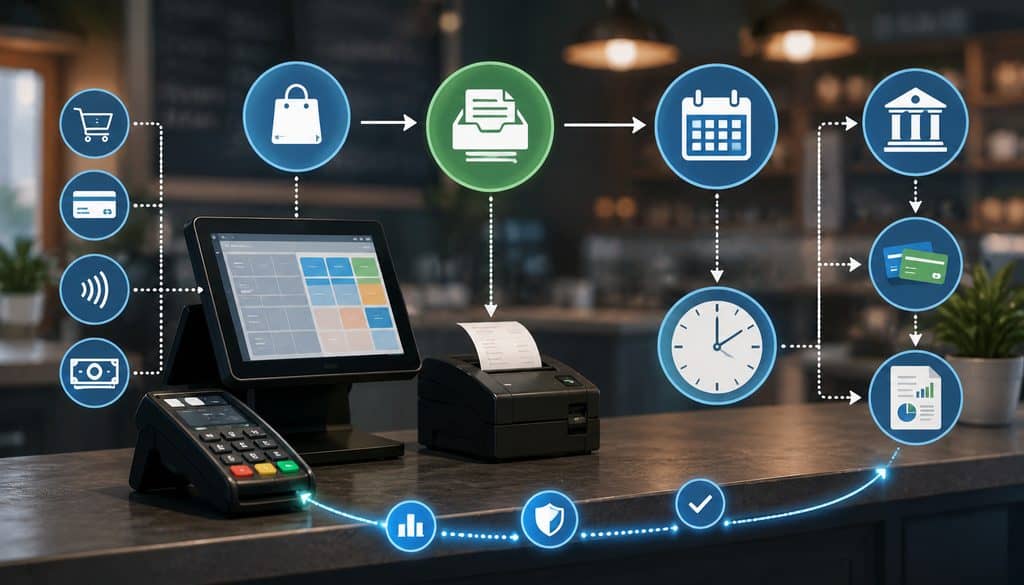
A POS batch is a grouping of payment transactions that the POS, gateway, terminal environment, or processor associates for submission or settlement processing.
The important issue for reconciliation is not simply the batch number. Finance needs to understand the sequence of dates around that batch:
Transaction Time → POS Business Date → Batch Close → Processor Submission → Settlement Date → Funding Date → Bank Posting Date
These dates can differ without anything being wrong.
A transaction completed at 11:57 p.m., for example, may belong to the current calendar day. A restaurant transaction completed after midnight might still belong to the prior operational business day if its POS is configured that way.
Automatic and Manual Batch Close
Some payment environments close batches automatically. Others allow configuration, require manual action, or use a combination of POS and processor rules.
The correct batch-close process must therefore come from the merchant’s actual POS and processing configuration.
A missed or delayed close can shift transactions into a later settlement period. Other possible batch exceptions include:
- incomplete batch close;
- late batch finalization;
- incorrect close configuration;
- transactions spanning unexpected business dates;
- tip adjustments delaying final values;
- duplicate imports that appear to finance as duplicate batches.
A multi-location company should document the expected close method for every merchant account. Do not assume two stores using the same POS brand have identical processor configurations.
This is especially important after implementation or migration. A useful preproduction review can include the considerations outlined in this article about migrating to a cloud-based merchant platform.
Business Date vs. Calendar Date
Business date is an operational accounting field; calendar date is a timestamp concept.
A restaurant that operates until 2 a.m. may decide that transactions from 12:01 a.m. through closing belong to the prior service day. A retailer operating conventional daytime hours may use calendar dates directly.
Corporate reconciliation should preserve the POS business date rather than rewriting every transaction to match bank dates.
For multi-time-zone organizations, keep at least two concepts when possible:
- local business date;
- standardized settlement or processing timestamp.
Doing so allows corporate finance to compare locations consistently without destroying the operating date used by local managers.
Why Gross Sales Differ From the Bank Deposit
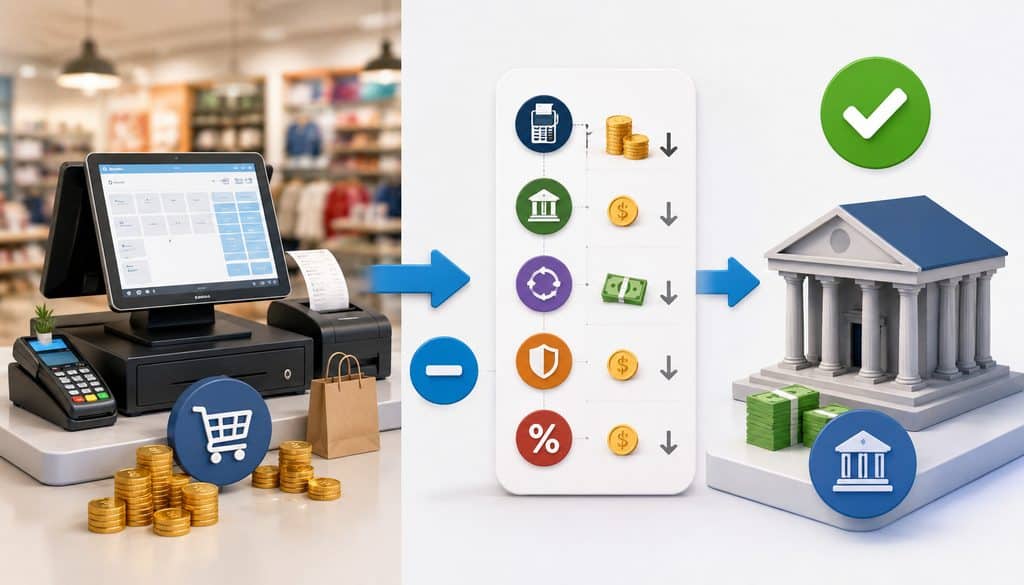
Gross sales, gross card sales, processor settlement, and bank funding are different measurements.
Gross POS sales may include cash, credit cards, debit cards, gift cards, store credit, third-party payments, and other tenders.
Gross card sales are the card transactions relevant to the processor being reconciled.
The expected processor funding can often be modeled conceptually as:
Gross Card Sales
− Settled Refunds
− Fees Netted From Funding
− Chargebacks
− Reserves or Holds
± Other Funding Adjustments
= Expected Processor Funding
The exact calculation must match the merchant’s processor agreement and reporting structure.
Gross-to-Net Deposit Example
Consider a hypothetical location with the following processor activity:
| Item | Hypothetical Amount |
| Gross card sales | $25,000 |
| Less settled refunds | ($400) |
| Less fees deducted with funding | ($310) |
| Less chargeback debit | ($250) |
| Less reserve/hold | ($100) |
| Plus prior adjustment | $0 |
| Expected net deposit | $23,940 |
If the bank posts $23,940 and the processor report shows those components, the difference from $25,000 is explained.
That does not mean every processor deducts all fees daily. Some merchants receive funding closer to gross card proceeds while fees are collected separately or billed later. Other agreements use net funding.
Consequently, finance should not create a generic formula and apply it to every MID without validating actual funding rules.
Gross Funding vs. Net Funding
Under gross funding, transaction proceeds are deposited with fewer deductions in the daily funding event, while fees or other costs may be collected separately.
Under net funding, some fees and financial adjustments are deducted before money reaches the bank.
The difference affects daily merchant deposit matching.
If fees are taken monthly, the daily POS-to-bank calculation should not deduct those monthly fees from every expected deposit. Instead, they should be reconciled separately when the processor debits or bills them.
Processing costs may include, depending on the merchant arrangement:
- interchange-related amounts;
- network assessments;
- processor markup;
- gateway charges;
- per-transaction charges;
- recurring service fees;
- other contractually agreed charges.
Do not assume every fee category is separately visible in a daily settlement report.
Separating Refunds, Fees, Tips, Chargebacks, and Reserves
Net deposit matching becomes easier when finance stops treating every deduction as one generic “adjustment.”
Refunds, processing fees, tips, chargebacks, and reserves represent different economic events and should remain separately visible in payment settlement reporting and the GL where appropriate.
| Item | Payment Activity? | Revenue? | Separate Tracking Recommended? |
| Card sale | Yes | Generally tied to sale | Yes |
| Customer tip | Yes | Usually not ordinary merchant sales revenue | Yes |
| Refund | Yes | Reversal/reduction related to prior sale | Yes |
| Processor fee | Yes | No | Yes |
| Chargeback | Yes | Dispute-related debit | Yes |
| Reserve/hold | Funding-related | No new revenue | Yes |
Accounting classification depends on the facts, entity structure, and applicable accounting policies, so businesses should confirm treatment with qualified accounting professionals.
Refunds, Voids, and Chargebacks
A void generally prevents or reverses a transaction before final settlement, subject to provider timing and processing rules. A refund typically creates a later financial transaction after a payment has been captured or settled.
That distinction affects the batch.
A same-day void may mean the original transaction never becomes part of expected funding. A refund processed three days later can reduce a later settlement even though it relates to an earlier sale.
Chargebacks require still different treatment.
A chargeback may occur well after the original transaction. Finance should therefore track:
Original Sale → Chargeback Debit → Representment or Reversal Credit, if any
Do not force a chargeback debit into the original day’s deposit reconciliation. Instead, identify it as a later processor adjustment and maintain linkage to the original transaction where reporting allows.
Chargeback reversals should likewise remain visible rather than being silently netted against new sales.
Tips and Service Charges
For restaurants, the card amount settled by the processor can include both the base sale and customer tip.
The useful payment view is:
Base Sale + Customer Tip = Total Card Charge
Accounting and payroll treatment, however, may require the tip to remain distinct from ordinary sales revenue. The IRS specifically distinguishes voluntary tips from compulsory service charges and states that service charges distributed to employees are treated differently for federal tax purposes.
The Department of Labor likewise distinguishes compulsory service charges from tips for federal wage purposes.
That means finance should not merge “tips” and “service charges” simply because both can appear on a POS receipt.
A practical restaurant reconciliation should retain:
- base transaction amount;
- voluntary tip;
- mandatory service charge where applicable;
- tax;
- total card charge;
- tip payable or payroll-related amount;
- processor-funded amount.
This allows card settlement reconciliation to work without losing payroll and accounting distinctions.
Payment Clearing Accounts
A payment clearing account provides an accounting bridge between recorded card activity and later cash deposits.
Conceptually:
POS/Card Activity → Payment Clearing Receivable → Processor Deposit → Bank
Suppose the POS establishes $10,000 expected from the processor. Finance records that amount through its chosen accounting process into card clearing. When the processor funds $9,850 and a separately identified $150 deduction is recorded correctly, the clearing balance can resolve.
A multi-location business might use:
- one clearing account per location;
- one per MID;
- one per processor;
- one consolidated clearing account with location and MID dimensions.
There is no universal best structure. The right model depends on accounting-system capabilities, entity separation, processor complexity, and reporting needs.
Inter-Location Transfers Are Not Payment Revenue
One of the most damaging multi-location accounting mistakes is treating an internal cash movement as another merchant deposit.
The distinction should be explicit:
Customer Payment = operating receipt
Inter-Location Transfer = movement of cash that already exists
If Store A’s processor deposits $20,000 into an operating account and treasury later sweeps that $20,000 into a concentration account, the company did not earn $40,000.
The first event is payment funding. The second is a treasury movement.
Identifying Transfers Correctly
Finance should establish dedicated transfer classifications for activity such as:
- store-to-store transfer;
- concentration sweep;
- cash-pool movement;
- corporate funding transfer;
- intercompany transfer;
- franchise settlement transfer where applicable;
- bank-account rebalancing.
| Transfer Date | From | To | Amount | Transfer ID | Revenue Impact |
| Hypothetical date | Store operating account | Treasury account | $20,000 | TR-4581 | Generally zero for internal cash movement* |
*Subject to legal-entity and accounting structure.
Transfer IDs should be different from payment settlement IDs.
If several legal entities are involved, intercompany accounting may be required rather than simple same-entity transfer treatment. Independently owned franchisees, for example, should not be assumed to have interchangeable cash merely because corporate reporting can view their sales.
Bank Sweeps and Cash Concentration
Automatic sweeps can obscure merchant funding when analysts rely on ending bank balances.
Imagine a processor deposits $30,000 at 6 a.m. Treasury sweeps $27,000 into a concentration account at noon. The location account ends the day with only $3,000.
Looking only at ending cash could incorrectly suggest that processor funding was $3,000.
The correct reconciliation preserves both events:
- processor deposit: $30,000;
- treasury sweep: $27,000.
The original merchant settlement remains fully traceable even after cash moves elsewhere.
Never use the ending bank balance as a substitute for payment revenue.
Settlement Timing, Cutoffs, Weekends, and Bank Holidays
Settlement timing is one of the most common reasons legitimate deposits appear “missing.”
Finance should track at least these dates separately:
- transaction date;
- POS business date;
- batch-close date;
- processor settlement date;
- funding initiation date;
- expected bank posting date;
- actual bank posting date.
A processor’s cutoff, the merchant’s batch configuration, location time zone, bank processing, weekends, and holidays can all affect the relationship among those dates.
Cutoff Times and Expected Deposit Dates
There is no universal merchant funding cutoff.
A processor may use one schedule while another uses a different schedule. Even within one provider, funding arrangements can depend on merchant account configuration, settlement service, risk controls, or bank relationship.
Finance should therefore obtain the actual cutoff and funding rules associated with each MID instead of hard-coding “T+1” or another generic assumption.
A good expected-deposit engine uses:
- processor-specific configuration;
- actual batch-close time;
- business date;
- location time zone;
- funding arrangement;
- banking calendar;
- known holds or exceptions.
Expected dates should be rules-driven but adjustable.
Processor agreements matter here. Visa’s acquirer standards state that acquirers are responsible for settlement according to contractual arrangements and recognize circumstances such as agreed deductions, reserves, and investigations.
Bank Holidays and Weekend Effects
Payment-processing activity and bank posting do not always follow identical calendars.
Federal Reserve Financial Services publishes specific holiday schedules and FedACH operating information. Those schedules demonstrate why businesses should account for nonstandard processing days rather than assume deposits post every calendar day.
A merchant might therefore see:
- POS operations continue normally;
- batches close successfully;
- processor records update;
- bank posting occur later.
Weekend activity can also behave differently depending on the processor and bank. Several weekend batches might appear in later funding, or they may remain separately identifiable.
The correct rule is not “weekend sales deposit Monday.” The correct rule is use the merchant’s actual provider and banking configuration.
| Business Date | Batch Close | Processor Settlement | Expected Bank Posting | Actual Bank Posting |
| Example Day 1 | Recorded | Recorded | Expected Date A | Date A |
| Example Day 2 | Recorded | Recorded | Expected Date B | Date B |
| Example Day 3 | Recorded | Pending | Expected Date C | Pending |
Pending bank transactions should normally remain distinct from final posted entries because pending descriptions, amounts, or posting dates can change.
Transfer Timing vs. Settlement Timing
A processor-funded bank deposit and a later corporate transfer are separate financial events even if they occur on the same date.
Settlement timing answers, “When did processor funds reach the merchant account?”
Transfer timing answers, “When did treasury move existing cash somewhere else?”
Maintaining separate timestamps prevents a common error in which a sweep out of the settlement account is interpreted as a processor adjustment.
This is especially important in concentration-account structures where payment deposits may remain in a location account for only a short period.
Cloud POS, Processor, and Bank Data Finance Should Capture
Multi-location deposits are easiest to reconcile when finance builds a normalized data model rather than manually comparing dashboards.
The POS, processor, bank, and GL should each contribute different fields.
Useful POS reports can include:
- daily sales summary;
- tender report;
- card payment report;
- batch report;
- refund and void reports;
- tip report;
- tax report;
- location report.
Modern POS systems can provide detailed sales and operational reporting by period, employee, department, and other dimensions, making them an important operational source for reconciliation. This overview of POS reporting capabilities can provide additional context on the types of data businesses may retrieve from a POS system.
Cloud reporting improves centralized visibility, but businesses should still determine which system owns each data point. The reporting and accounting-integration potential of modern platforms is discussed further in this overview of data accessibility in cloud payment tools.
Processor Settlement Data
The processor dataset should capture as many of the following as the provider exposes:
- legal entity or merchant hierarchy;
- MID;
- processor batch;
- POS batch reference if available;
- gross transaction amount;
- refunds;
- processing-fee deductions;
- chargebacks;
- reserves;
- other adjustments;
- net funding amount;
- settlement ID;
- funding ID;
- funding date.
The bank feed should then capture:
- bank account alias;
- posted amount;
- posting date;
- bank reference;
- transaction type;
- ACH or other available reference data.
Free-form bank descriptors can help, but they should not be the primary match when stronger identifiers are available.
Recommended Reconciliation Data Model
A practical record may contain:
- legal entity;
- region;
- location;
- store ID;
- MID;
- terminal/channel;
- POS batch ID;
- processor batch ID;
- settlement ID;
- funding ID;
- business date;
- settlement date;
- gross sales;
- gross card sales;
- refunds;
- tips;
- fees;
- chargebacks;
- reserves;
- adjustments;
- expected funding;
- actual bank amount;
- bank posting date;
- bank reference;
- GL clearing reference;
- reconciliation status;
- exception category;
- exception owner;
- age;
- resolution note.
This structure preserves both location-level detail and corporate roll-up capability:
Location → MID → Region → Entity → Corporate
Daily Multi-Location Payment Reconciliation Workflow
A repeatable daily process is more valuable than an elaborate month-end cleanup.
The finance team should begin with the prior completed business period rather than immediately opening the bank portal and attempting to guess which deposits correspond to sales.
A practical workflow is:
- Confirm expected batches: Verify that locations completed or generated their expected batches.
- Export POS tender totals: Separate card activity from cash, gift cards, and other payment types.
- Obtain processor settlement data: Capture MID, batch, adjustments, funding IDs, and expected funding.
- Map by location and MID: Validate the location-to-MID master file.
- Calculate expected funding: Apply the documented gross-to-net logic for that merchant account.
- Import posted bank transactions: Do not treat pending items as final.
- Match settlements to deposits: Prefer identifiers before amount-only logic.
- Classify timing differences: Keep legitimate in-transit funding separate from actual discrepancies.
- Identify true exceptions: Missing funding, wrong amount, wrong location, duplicates, and unexplained adjustments should surface.
- Assign an owner: Every unresolved exception should have responsibility attached.
- Clear resolved items: Document the explanation and evidence.
- Retain the audit trail: Preserve original data and reconciliation history.
This process transforms merchant funding reconciliation into an evidence chain rather than a daily guessing exercise.
The Daily Payment Reconciliation Exception Report
The daily exception report should be the finance team’s prioritized list of payment activity that did not reconcile automatically or has not yet reached its expected state.
It should not be a dump of every transaction.
At minimum, useful fields include:
- business date;
- legal entity;
- location;
- MID;
- POS batch ID;
- processor batch or settlement ID;
- POS card total;
- processor gross;
- refunds;
- fees;
- chargebacks or adjustments;
- expected funding;
- actual bank deposit;
- bank posting date;
- variance;
- timing status;
- exception category;
- owner;
- age;
- resolution status.
| Location | Batch ID | POS Card Sales | Expected Funding | Bank Deposit | Variance | Exception | Age |
| Store A | B-101 | $12,400 | $12,250 | $12,250 | $0 | None | — |
| Store B | B-102 | $8,100 | $8,060 | $0 | $8,060 | Timing review | 1 day |
| Store C | B-103 | $9,500 | $9,410 | $9,360 | $50 | Amount mismatch | 1 day |
These figures are hypothetical.
Exception Categories Finance Should Use
Standardized categories make recurring problems visible.
Useful categories include:
- timing difference;
- missing deposit;
- duplicate deposit;
- wrong location or MID;
- fee difference;
- refund mismatch;
- chargeback adjustment;
- unidentified bank transfer;
- batch mismatch;
- unresolved processor adjustment;
- incorrect bank destination;
- duplicate data import.
A timing difference should not be labeled a missing deposit merely because bank posting has not occurred on the first day.
Tracking exception age is especially important. Unresolved differences should not disappear into a general suspense account without ownership and evidence.
There is no universal escalation threshold. Finance should establish materiality, age, and risk-based escalation rules appropriate to the organization.
Missing Deposit Investigation
For a missing deposit:
- confirm the location’s batch completed;
- verify that the processor received the batch;
- locate the processor settlement;
- check funding status;
- validate expected posting date;
- check for reserves, holds, or adjustments;
- verify the destination bank account;
- check posted bank activity;
- escalate through the processor’s support process if unresolved.
This sequence identifies where the chain broke.
If no settlement exists, the issue may be POS-to-processor. If settlement exists but funding is held, it is a processor funding issue. If funding is shown as completed but the bank cannot locate it, the investigation moves to processor-to-bank evidence.
Wrong Amount, Duplicate Deposit, and Wrong Location
A wrong-amount investigation can be decomposed as:
POS Difference + Refund Difference + Fee Difference + Chargeback/Adjustment Difference + Timing Difference = Unexplained Variance
A duplicate-looking deposit should be checked against:
- two legitimate funding events;
- duplicated processor records;
- duplicate bank-feed import;
- duplicate GL posting.
Never assume the processor paid twice until data duplication has been eliminated.
A wrong-location exception may arise from an incorrect MID mapping, incorrect GL dimension, or settlement routed to an unexpected bank account.
Funding to an unauthorized or unexpected bank account should receive high-priority review using controlled verification procedures.
Recommended bank-change controls include dual approval, MFA, audit logging, processor confirmation, and verification through trusted contact channels rather than relying solely on an inbound request.
Auto-Matching and Reconciliation Automation
Automation can reduce repetitive reconciliation work, but only when matching logic reflects real settlement relationships.
Useful auto-match attributes include:
- MID;
- settlement ID;
- funding ID;
- batch ID;
- amount;
- expected date window;
- bank reference.
Exact identifiers are generally preferable to fuzzy matching.
An amount-only rule can easily match the wrong location when identical deposit amounts occur.
Many-to-One and One-to-Many Matching
A mature reconciliation engine should support:
Multiple Batches → One Deposit
and, where the processor structure requires it:
One Settlement/Funding Relationship → Multiple Bank Entries
The engine should preserve the component records rather than collapsing them into an unexplained summary.
For example, three batches of $3,000, $4,000, and $5,000 might be associated with one $12,000 funding event. The system should mark all three batches as reconciled to the same deposit while retaining the relationship.
Similarly, split funding may cause related proceeds to move to approved accounts separately. Availability and structure are provider-specific and should be verified rather than assumed.
API, CSV, SFTP, and Manual Exports
| Method | Advantage | Limitation |
| API | Frequent structured automation | Requires development and monitoring |
| CSV/SFTP | Repeatable batch processing | File timing/schema changes need controls |
| Manual export | Easy to begin | Labor-intensive and error-prone at scale |
Webhooks can help update transaction or settlement status quickly, but they should not replace reconciliation to final posted bank transactions.
Automated imports should also be idempotent: loading the same processor file or event twice should not create duplicate settlements or GL activity.
Consistent extraction windows matter. POS, processor, and bank data should use deliberately aligned periods so that mismatched time windows do not create false payment reconciliation exceptions.
Month-End Clearing and Processor Statement Reconciliation
Daily matching reduces month-end workload, but month-end requires additional controls.
Finance should review:
- unresolved timing differences;
- payments in transit;
- accrued or separately billed fees;
- open chargeback activity;
- reserves and reserve releases;
- transfers in transit;
- unmatched deposits;
- settlement receivables;
- processor statement totals;
- GL clearing balances.
A batch that has settled with the processor but has not posted to the bank may remain part of the processor receivable or payment clearing balance, depending on the organization’s accounting policy.
A conceptual clearing rollforward is:
**Opening Clearing Balance
- New Card Activity
− Bank Deposits
− Recognized Adjustments
= Ending Clearing Balance**
The ending balance should be explainable.
Processor Statement Reconciliation
Daily settlement reports should ultimately tie to the merchant’s periodic processor statement where applicable.
This helps identify fees and adjustments that may not have appeared in daily funding.
If the statement reports costs that were billed separately, finance should avoid forcing those charges into historical daily deposit records simply to make a statement total match.
The statement is also useful for processing-cost analysis.
A commonly used calculation is:
Effective Processing Rate = Total Included Processing Cost ÷ Card Processing Volume × 100
But that analysis should remain separate from deposit matching. Different locations may show different effective costs because of card mix, ticket size, channel, refunds, or pricing—not because reconciliation failed.
Multi-Location Roll-Up and Scorecards
Corporate finance can aggregate payment performance through:
Location → MID → Region → Entity → Corporate
without discarding location-level traceability.
A location reconciliation scorecard can monitor:
- number of reconciled batches;
- unmatched deposits;
- aged exceptions;
- recurring settlement delays;
- incorrect MID mappings;
- repeated batch-close problems;
- unresolved processor adjustments.
Avoid arbitrary universal performance percentages. The value comes from observing trends and identifying recurring configuration problems.
Accounting, Tax, Gift Card, and Third-Party Deposit Considerations
Card settlement is only one source of funds in a multi-location business.
Tax collected from customers may be included in the customer’s card payment but should remain separately identifiable according to the company’s accounting and tax requirements.
Gift cards require additional distinction. A gift card sale, gift card redemption, and processor deposit are different events. The timing of payment and revenue recognition may differ depending on applicable accounting and legal requirements.
Third-party marketplace and delivery deposits should also remain identifiable. A restaurant receiving direct processor funding plus deposits from a delivery marketplace should not combine both into one unexplained “card deposit” category.
Cash deposits belong in a separate cash-reconciliation process.
Bank fees should not automatically be classified as payment processor fees merely because they appear in the same account.
These distinctions help prevent a bank feed from becoming the primary accounting logic. The bank records cash movement, but it does not necessarily explain the business purpose behind each movement.
Security, PCI DSS, and Reconciliation Data
Finance does not need full payment-card data to reconcile deposits.
Routine reconciliation reports generally need identifiers such as:
- transaction reference;
- batch ID;
- MID;
- settlement ID;
- funding ID;
- amount;
- masked account information where genuinely necessary.
They do not need full PAN, CVV, PIN, or other sensitive authentication data.
PCI Security Standards Council guidance states that card verification codes are sensitive authentication data and cannot be stored after authorization, even when encrypted.
PCI guidance also emphasizes limiting cardholder-data retention to legitimate legal, regulatory, or business needs.
Never export full card data simply to make reconciliation easier.
Modern cloud environments can support centralized reporting without turning finance files into repositories of unnecessary payment credentials.
Audit Trail and Segregation of Duties
A strong audit trail preserves:
- original POS batch;
- processor settlement record;
- bank reference;
- exception classification;
- investigation evidence;
- correction;
- approver;
- resolution date.
Historical records should not be silently overwritten when reconciliation adjustments are made.
Each adjustment should document:
- amount;
- reason;
- source;
- posting period;
- preparer;
- approver.
Where practical, separate responsibility for POS administration, bank-account changes, reconciliation, journal posting, and exception approval.
Common Multi-Location Reconciliation Mistakes
Many recurring reconciliation problems come from flawed assumptions rather than missing data.
Common mistakes include matching bank deposits by amount only, confusing a MID with a batch ID, assuming every batch becomes one deposit, or expecting every business day’s card sales to arrive on the next calendar day.
Other errors include:
- mixing cash deposits with processor funding;
- counting inter-location transfers as revenue;
- hiding chargebacks inside net sales;
- ignoring employee-related tip balances;
- assuming all processor fees are deducted daily;
- relying on ending bank balances;
- combining locations without MID mapping;
- treating pending bank activity as final;
- clearing timing differences without evidence;
- leaving exceptions indefinitely in suspense;
- relying only on a cloud POS dashboard;
- failing to reconcile daily processor activity to periodic statements.
A well-designed reconciliation control matrix makes these risks explicit.
| Risk | Control |
| Missing deposit | Batch-to-settlement-to-bank tracking |
| Wrong MID | Maintained location-to-MID master |
| Wrong location | Location/MID validation |
| Fee mismatch | Separate fee reconciliation |
| Refund mismatch | Refund report-to-settlement comparison |
| Chargeback adjustment | Dedicated dispute tracking |
| Transfer misclassified as revenue | Separate treasury transaction codes |
| Timing difference | Expected posting calendar/status |
| Duplicate import | Idempotent import controls |
| Wrong bank account | Funding-account verification and escalation |
Daily, Weekly, and Month-End Finance Checklists
Daily controls should focus on whether expected payment activity progressed through settlement normally.
Daily finance checklist
- Confirm expected location batches.
- Review processor settlements.
- Import posted bank deposits.
- Match MID, batch, settlement, and funding IDs.
- Calculate expected net funding.
- Isolate legitimate timing differences.
- Review refunds.
- Review chargebacks and funding adjustments.
- Classify inter-location transfers.
- Assign unresolved exceptions.
- Update exception aging.
Weekly review should look for patterns rather than individual transactions.
Weekly review
- Identify locations with recurring unmatched batches.
- Review repeated settlement delays.
- Correct persistent MID mapping problems.
- Review older exceptions.
- Analyze unexplained processor adjustments.
- Confirm recurring timing issues are reflected correctly in matching rules.
At month-end:
- reconcile payment clearing balances;
- identify outstanding settlements;
- review reserves;
- tie settlement totals to processor statements;
- reconcile separately billed fees;
- review chargebacks and reversals;
- clear or explain inter-location transfers;
- verify bank-to-GL postings;
- document unresolved items.
Cloud POS Reconciliation Checklist
| Area | Verified? |
| Location-to-MID mapping | □ |
| POS batch IDs | □ |
| Processor settlement IDs | □ |
| Funding references | □ |
| Gross card totals | □ |
| Refunds | □ |
| Tips | □ |
| Fees | □ |
| Chargebacks | □ |
| Reserves/adjustments | □ |
| Expected deposit | □ |
| Actual bank deposit | □ |
| Inter-location transfers | □ |
| Timing differences | □ |
| Exception aging | □ |
| GL clearing | □ |
| Audit trail | □ |
The checklist is useful during implementation, acquisitions, processor changes, store openings, and accounting-system migrations.
It is especially valuable when several locations share the same POS brand but use different MIDs or funding accounts.
Questions to Ask Your POS Provider, Processor, and Finance Team
Reconciliation works best when key questions are answered before an exception occurs.
Ask the cloud POS provider:
- What batch identifiers are available?
- Can each report expose MID and location?
- Is business date separate from calendar date?
- Can batch reports be exported automatically?
- How are refunds and tips represented?
- Can processor settlement records be integrated?
- Are settlement or funding IDs exposed?
- Can one corporate dashboard report multiple MIDs?
- How are location time zones handled?
- Does the API expose batch-level records?
- How are late tip adjustments handled?
- How much historical batch data can be exported?
Ask the processor or acquirer:
- Which field connects our batch to your settlement?
- Is each batch always funded separately?
- Can several batches be combined into one deposit?
- Which fees are deducted from daily funding?
- Which charges are billed separately?
- How do refunds appear in settlement data?
- How are chargebacks, reserves, and reserve releases shown?
- Which funding identifier reaches our bank?
- What cutoff applies to each MID?
- How do weekends and banking holidays affect our configuration?
- Can settlement data be exported by MID?
- How are held or missing deposits identified?
- How much settlement history is available?
Internally, finance should decide:
- What is the official source for gross card activity?
- What clearing-account structure will be used?
- Which matching identifiers are mandatory?
- How are timing differences classified?
- How are treasury transfers separated from revenue?
- Who owns exception resolution?
- How are aged items escalated?
- Which report is reviewed every day?
- Who approves reconciliation adjustments?
- What supporting evidence must be retained?
Frequently Asked Questions
What is multi-location payment reconciliation?
Multi-location payment reconciliation matches each location’s POS card activity to processor batches and settlement records, then matches those settlements to actual bank deposits and GL entries.
The process maintains location, MID, batch, funding, and timing information so finance can explain where every funded amount originated and why the deposit may differ from POS sales.
How do you reconcile cloud POS sales to bank deposits?
Start with location-level card tender totals, identify the associated POS and processor batches, obtain processor settlement and funding records, calculate expected net funding, and match the funding event to the posted bank transaction. Then classify timing differences and adjustments before posting or clearing the accounting balance.
Which ID links a POS batch to a processor deposit?
There is no universal ID. Depending on the provider, reconciliation may use a POS batch ID, processor batch number, settlement ID, funding ID, MID, transaction reference, bank reference, or a combination of fields. Finance should ask the processor which batch-level reference is retained through funding.
Why does my POS show more sales than my bank deposit?
The POS may show gross card activity while the deposit reflects refunds, processor fees, chargebacks, reserves, holds, or other funding adjustments. Timing can also move some transactions into a later settlement. First reconcile the POS to the processor’s settlement calculation before treating the difference as missing money.
What is the difference between gross and net settlement?
Gross settlement or funding generally refers to funding before certain merchant-level deductions, while net funding reflects deductions or adjustments made before the deposit. Actual terminology and treatment vary by provider. Review the merchant’s settlement report and agreement rather than assuming all fees are deducted daily.
Can multiple POS batches appear as one bank deposit?
Yes. A processor may aggregate multiple batches into one funding event depending on its processing and merchant configuration. Reconciliation software should therefore support many-to-one matching while retaining the individual batch records associated with the combined deposit.
Why can one business day create multiple deposits?
Several MIDs, multiple locations, separate online and in-store channels, split funding arrangements, or processor funding logic can produce multiple bank deposits for one business date. Reconcile each deposit to its processor funding record rather than expecting one combined deposit for the day.
How should processor fees be reconciled?
Determine which fees are deducted from daily funding and which are billed or debited separately. Daily net deposit matching should include only deductions actually associated with that settlement. Periodic charges should be reconciled when they appear on the merchant statement, invoice, or bank account.
How should refunds and chargebacks be recorded?
Refunds should remain identifiable as reversals related to customer payments, while chargebacks should be tracked as dispute-related debits linked to the original transaction when possible. Chargeback reversals or representment credits should be tracked separately rather than invisibly netted into current sales.
How should restaurant tips be handled in POS reconciliation?
Include the tip when reconciling the total card charge to processor settlement, but keep the tip component separately identifiable for payroll and accounting purposes. Do not automatically classify voluntary tips and mandatory service charges the same way; federal tax and wage guidance distinguishes them.
How do you keep inter-location transfers from being counted as revenue?
Assign bank sweeps, cash concentration movements, store transfers, and other internal transfers their own treasury or intercompany transaction categories. Match those transfers between originating and receiving accounts rather than to POS batches. Moving already-earned cash between accounts does not create another customer sale.
How do weekends and bank holidays affect merchant deposits?
They can change when funding appears in the bank even if the POS closes normally. Actual behavior depends on the processor, funding arrangement, banking network, and receiving bank. Use the processor’s documented funding rules and applicable banking calendar rather than assuming a universal next-business-day schedule.
What should a daily payment reconciliation exception report contain?
Include business date, location, MID, batch and settlement identifiers, POS card total, processor gross amount, refunds, fees, chargebacks, expected funding, actual deposit, variance, timing status, exception category, owner, age, and resolution status. The report should focus attention on items that require action or documented monitoring.
How should unmatched deposits be investigated?
Start with the bank transaction and identify its funding reference, processor, MID, account, amount, and date. Search processor funding records before attempting to match directly to POS sales. Also eliminate treasury transfers, third-party marketplace deposits, duplicate imports, and other non-processor credits before classifying the item as unidentified.
What should be reconciled at month-end for multiple locations?
Month-end should reconcile processor clearing accounts, payments in transit, reserves, refunds, chargebacks, fees, inter-location transfers, unmatched deposits, processor statements, and bank-to-GL activity. Every remaining clearing balance should have a documented explanation, supporting record, responsible owner, and expected resolution path.
Conclusion
Reconciling cloud POS deposits across multiple locations is not a matter of comparing yesterday’s sales number with today’s bank deposit.
The reliable approach follows the entire financial chain:
Location Sale → POS Transaction → POS Batch/Business Day → Processor Batch → Settlement Record → Fees/Refunds/Adjustments → Bank Deposit → GL Posting → Exception Review
Each step provides different evidence.
The POS explains customer payment activity. The processor explains clearing, settlement, funding, deductions, and adjustments. The bank confirms posted cash. The general ledger determines how those events are recorded financially.
The strongest multi-location accounting processes preserve location and MID mapping, distinguish batch IDs from settlement and funding IDs, calculate gross-to-net funding explicitly, keep tips, refunds, fees, chargebacks, and reserves visible, and separate treasury transfers from operating receipts.
They also treat timing as a documented variable rather than assuming every location receives next-day funding.
When finance uses reliable identifiers, maintains a location-to-MID master file, supports many-to-one settlement matching, and reviews a structured exception report daily, missing deposits become easier to investigate and false exceptions decline.
Most importantly, a good reconciliation system can answer five questions for every deposit: which location earned it, which MID processed it, which batches produced it, what adjustments changed it, and when the cash reached the bank.
That traceability is the foundation of accurate POS-to-bank reconciliation and scalable multi-location accounting.
This article provides general payment-operations and accounting information. Settlement behavior, batch identifiers, funding schedules, fee treatment, accounting classification, and legal-entity requirements vary.
Businesses should verify processor-specific behavior with their POS provider, processor/acquirer, and bank, and confirm accounting treatment with qualified accounting professionals.